
Indigenous Systems Framework
offered analytical lenses to facilitate interpreting Indigenous systems
The framework presented here approaches Indigenous systems as operating through integrated relationships among land, knowledge, livelihoods, culture, climate, and one another. These systems develop through continuous interaction between communities and the environments they inhabit, shaped by ecological conditions, cultural traditions, and intergenerational knowledge.
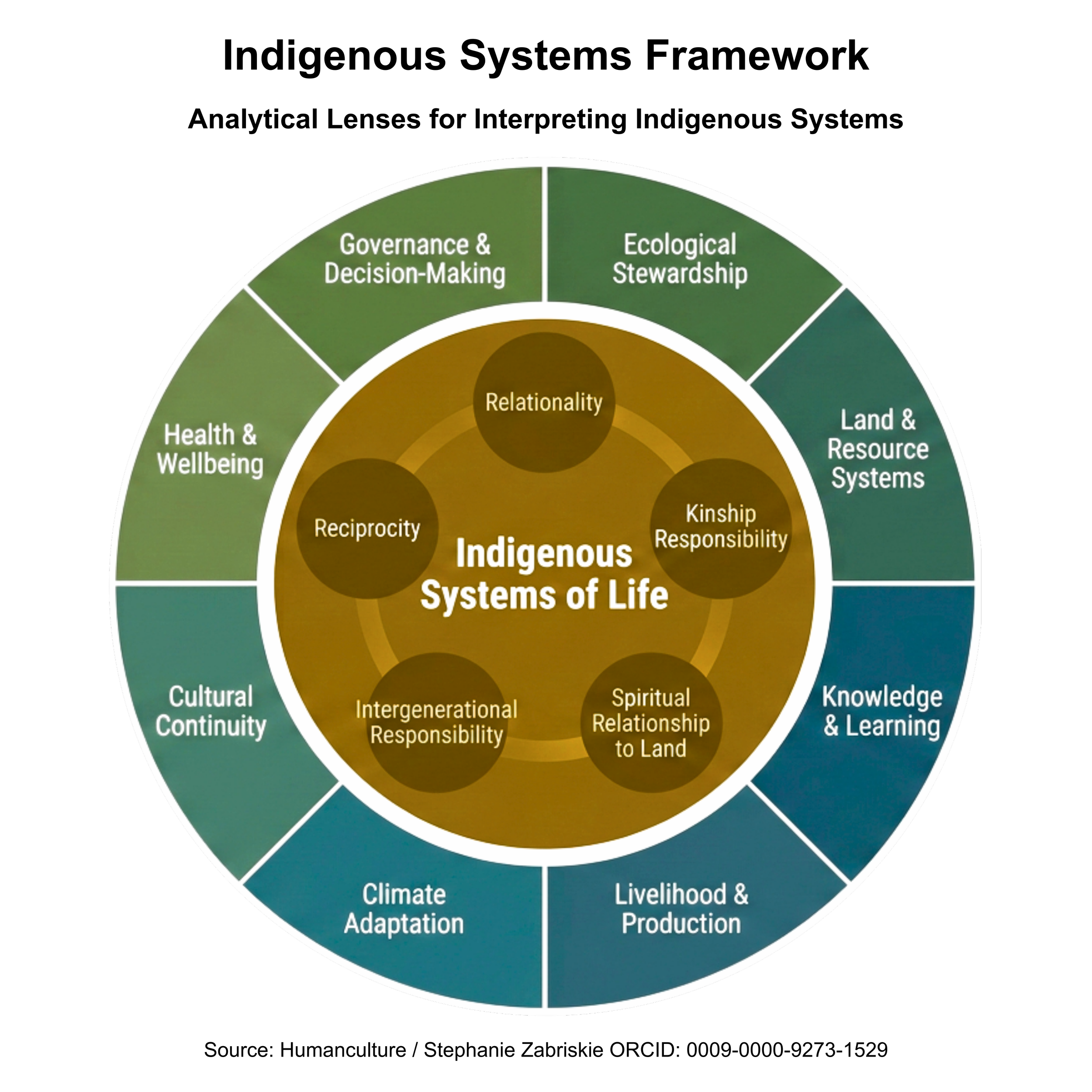
For analytical clarity, the framework presented here organizes these systems through several lenses that correspond to the ways international institutions and research communities commonly encounter Indigenous systems. Indigenous communities experience them as integrated systems of life grounded in principles of relationality, reciprocity, kinship, spiritual relationship to land, and intergenerational responsibility.
These lenses represent analytical perspectives rather than separate systems. Within Indigenous communities, these dimensions operate together as an integrated whole. The framework does not define Indigenous systems themselves, rather it is provided as an analytical tool for understanding the organization and scope of the work documented on this platform.
Foundational Principles Indigenous Systems of Life
Relationality
Recognition that all living beings and environments exist in interconnected relationships rather than separate domains.
Reciprocity
An ethic of mutual responsibility in which relationships between people, land, and ecosystems involve care, balance, and return.
Kinship
Relationships among people, ancestors, future generations, and the living world that shape social organization and responsibility.
Relationship to Land
Recognition of land and place as sources of cultural meaning, spiritual relationship, and stewardship responsibility.
Intergenerational Responsibility
Commitments to sustaining knowledge, lands, and cultural practices for future generations.
Across many Indigenous contexts, foundational principles form the relational and ethical structure through which Indigenous systems function as integrated ways of life.
The foundational principles described here illuminate the relational nature through which Indigenous systems of life are organized, enacted, transmitted and renewed across generations. Frameworks such as the Five R’s—respect, relevance, reciprocity, responsibility, and relationship—express guiding behavioral principles that shape how knowledge is practiced and shared within those relationships.
Analytical Lenses
Indigenous systems operate as integrated systems of life. For analytical clarity, they can be viewed through several lenses that correspond to the ways international institutions and research communities commonly encounter these systems. Indigenous communities experience them as integrated systems of life.
Livelihood & Production
Cultural Continuity
Knowledge & Learning
Climate Adaptation
Ecological Stewardship
Governance & Decisions
Health and Wellbeing
Land & Resources
Indigenous Systems and Global Knowledge
Indigenous systems represent some of the longest-standing governance and ecological knowledge systems in the world.
Understanding how these systems function is increasingly important as global institutions confront challenges related to climate change, biodiversity loss, land degradation, and sustainable development. By documenting Indigenous systems and engaging with global research and policy communities, this platform seeks to contribute to a deeper understanding of how Indigenous knowledge and governance systems can inform global discussions about sustainability, resilience, and environmental stewardship.