
Research Brief
Pastoral Adaptation to Prolonged Drought in Morocco: Household Strategies Among Amazigh Nomadic Communities
Region: Africa
Associated Platforms
Food and Agriculture Organization of the United Nations (FAO)
Author: Stephanie Zabriskie
ORCID: 0009-0000-9273-1529
Affiliation: Humanculture (Indigenous-led nonprofit organization)
Capacity: Founder and Executive Director
_______________________________________________________
Summary
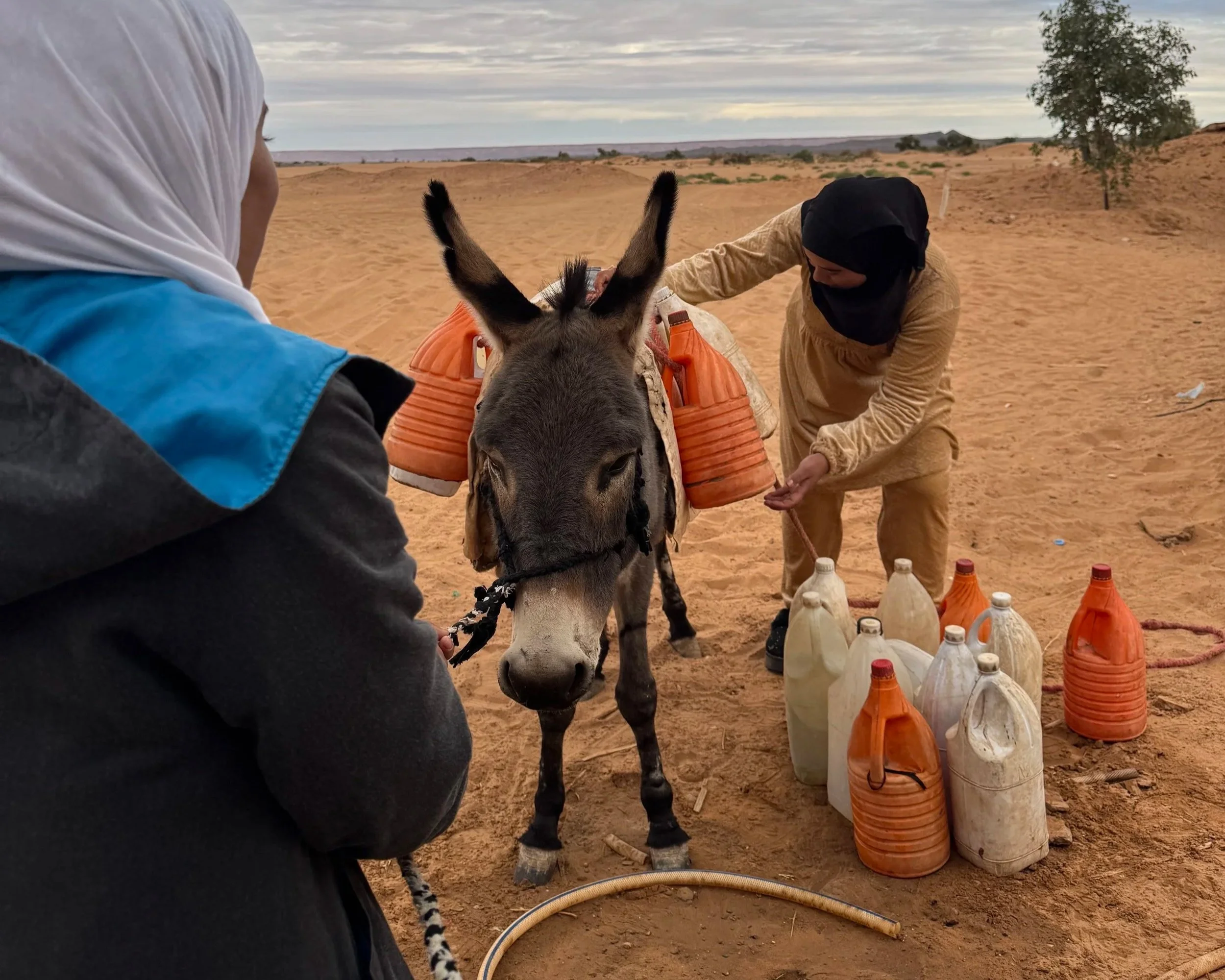
Prolonged drought between approximately 2018 and 2025 severely affected pastoral systems across southeastern Morocco, disrupting groundwater access, reducing forage availability, and causing significant livestock losses. Amazigh nomadic pastoral households responded by temporarily concentrating near reliable municipal water access points in the Merzouga area while maintaining their nomadic housing systems and social organization. Women assumed primary responsibility for daily water collection, traveling by foot or donkey to obtain water for both household consumption and remaining livestock. Households also adapted livestock strategies, shifting from camels toward goats and occasionally supplementing feed using available organic food remnants. These household-level responses illustrate how nomadic pastoral systems reorganize around water access under prolonged drought conditions while maintaining social continuity and mobility potential.
Context: Prolonged Drought and Pastoral Risk
Nomadic pastoralism in southeastern Morocco has historically depended on seasonal mobility across desert landscapes to maintain access to water and forage. Mobility enables households to locate shallow groundwater sources and respond to rainfall variability across wide territories.
Between approximately 2018 and 2025, Morocco experienced one of the most severe drought periods in recent decades. Across pastoral landscapes in the Saharan region of southeastern Morocco, groundwater sources became unreliable, vegetation declined sharply, and rainfall patterns no longer supported traditional mobility routes.
These conditions created acute livelihood risk for nomadic pastoral households. Camel herds proved particularly difficult to maintain under reduced water availability, and many families experienced significant livestock losses. Goats became the most viable remaining animals because they require less water and can survive on sparse forage.
Community Adaptation Practices
Beginning around 2022, Amazigh pastoral households increasingly concentrated near Merzouga, a desert settlement where municipal water infrastructure serves nearby tented desert camps. These water points became reliable nodes within an otherwise water-scarce landscape.
Women from pastoral households travel daily by foot or donkey to collect water from municipal taps located near the camps. Water is transported in repurposed containers back to temporary encampments where households continue living in tents and maintaining pastoral routines.
This pattern mirrors traditional desert water-point organization. Nomadic mobility historically structured daily life around reliable water sources; in this case the water node is municipal infrastructure rather than a natural oasis.
Households also restructured livestock strategies. Many families reduced or eliminated camel herds and retained goats, which are more resilient under drought conditions. While collecting water, households occasionally obtain organic food remnants from camp operations, which are sometimes used as supplemental feed for goats during periods of forage scarcity. This practice is informal and not a structured exchange system.
Despite the concentration near water access points, households continue to identify as nomadic pastoral communities. Their mobility has become temporarily concentrated near reliable water access rather than transitioning to permanent settlement.
Observed Outcomes
Access to reliable water points allowed households to sustain basic water needs for both people and livestock during the prolonged drought. The shift toward goat herding reduced water and forage requirements, helping households preserve some productive capacity.
The continued use of tents and temporary encampments allowed pastoral households to maintain social organization and livelihood practices consistent with nomadic identity. This continuity preserves the capacity for wider mobility if ecological conditions recover.
Although Morocco experienced heavy rainfall and snowfall during the 2025–2026 season and the government declared the drought officially over, the seven years of groundwater depletion and forage loss cannot be reversed by a single rainfall season, meaning that hydrological recovery and forage regeneration lag behind the official end of the drought period. The ecological conditions that sustained traditional nomadic mobility remain degraded. As a result, pastoral households continue to maintain proximity to reliable water access while monitoring ecological conditions.
Implications for Disaster Risk Reduction
The experience of Amazigh pastoral households in southeastern Morocco demonstrates several features of drought adaptation directly relevant to disaster risk reduction and the Sendai Framework for Disaster Risk Reduction 2015–2030.
Under Sendai Framework Priority 1 — understanding disaster risk — this case illustrates how nomadic pastoral systems carry embedded risk knowledge that enables households to recognize environmental thresholds and reorganize spatially around reliable water nodes when traditional mobility routes become unviable. This community-held risk knowledge is not captured in formal hazard assessments but functions as operational disaster risk management at the household level.
Under Sendai Framework Priority 4 — enhancing disaster preparedness for effective response — the adaptive strategies documented here demonstrate that pastoral households actively manage drought risk through adjustments to mobility, livestock composition, and resource access rather than abandoning pastoral systems entirely.
Additionally, women’s labor plays a central role in household water security during drought, as daily water collection becomes essential for sustaining both human and livestock needs. Recognizing this labor within disaster risk frameworks is essential for designing gender-responsive drought preparedness support in pastoral regions.
Recognizing pastoral adaptation practices such as these can strengthen drought preparedness policies in dryland regions where mobility, water access, and livestock management remain central to community resilience.
Documentation
Further documentation of this pastoral adaptation system is available through the FAO Family Farming Knowledge Platform:
Zabriskie, Stephanie. 2026. Pastoral Household Adaptation to Prolonged Drought Among Amazigh Communities in Southeastern Morocco. FAO Family Farming Knowledge Platform. Food and Agriculture Organization of the United Nations. https://www.fao.org/family-farming/detail/en/c/1758134/
