
Field Testimony
I Was Born With the Sun in My Eyes
An oral testimony from Ali on nomadic life, water, camels, and transition in the Sahara
Region: Africa
Associated Platforms
Humanculture
Author: Stephanie Zabriskie
ORCID: 0009-0000-9273-1529
Affiliation: Humanculture (Indigenous-led nonprofit organization)
Capacity: Founder and Executive Director
_______________________________________________________
Summary
Ali is an Amazigh man from the Erg Chebbi region of southeastern Morocco, near the Algeria border. Born into a nomadic family, he spent his early life in the Sahara before prolonged drought ended his family’s nomadic movement and brought them to the village. He is now the owner and operator of Horaz Luxury Camp, a family-run tented camp at the edge of the Merzouga dunes.
Since 2022, Humanculture has maintained an Indigenous-led initiative in Amazigh communities in Morocco’s Sahara, led by Amazigh women in the region. Horaz Luxury Camp is an Indigenous-owned, family-operated business in the Merzouga dunes. Supporting Indigenous-owned businesses in the communities where it works is a core part of Humanculture’s operating practice, including when bringing researchers and organized groups into the field.
This testimony was collected by Stephanie Zabriskie in a field conversation at Horaz Luxury Camp, Merzouga, Morocco, on December 10, 2025. It is published as primary source material documenting nomadic life, water access, ecological knowledge, and lived transition under conditions of drought.
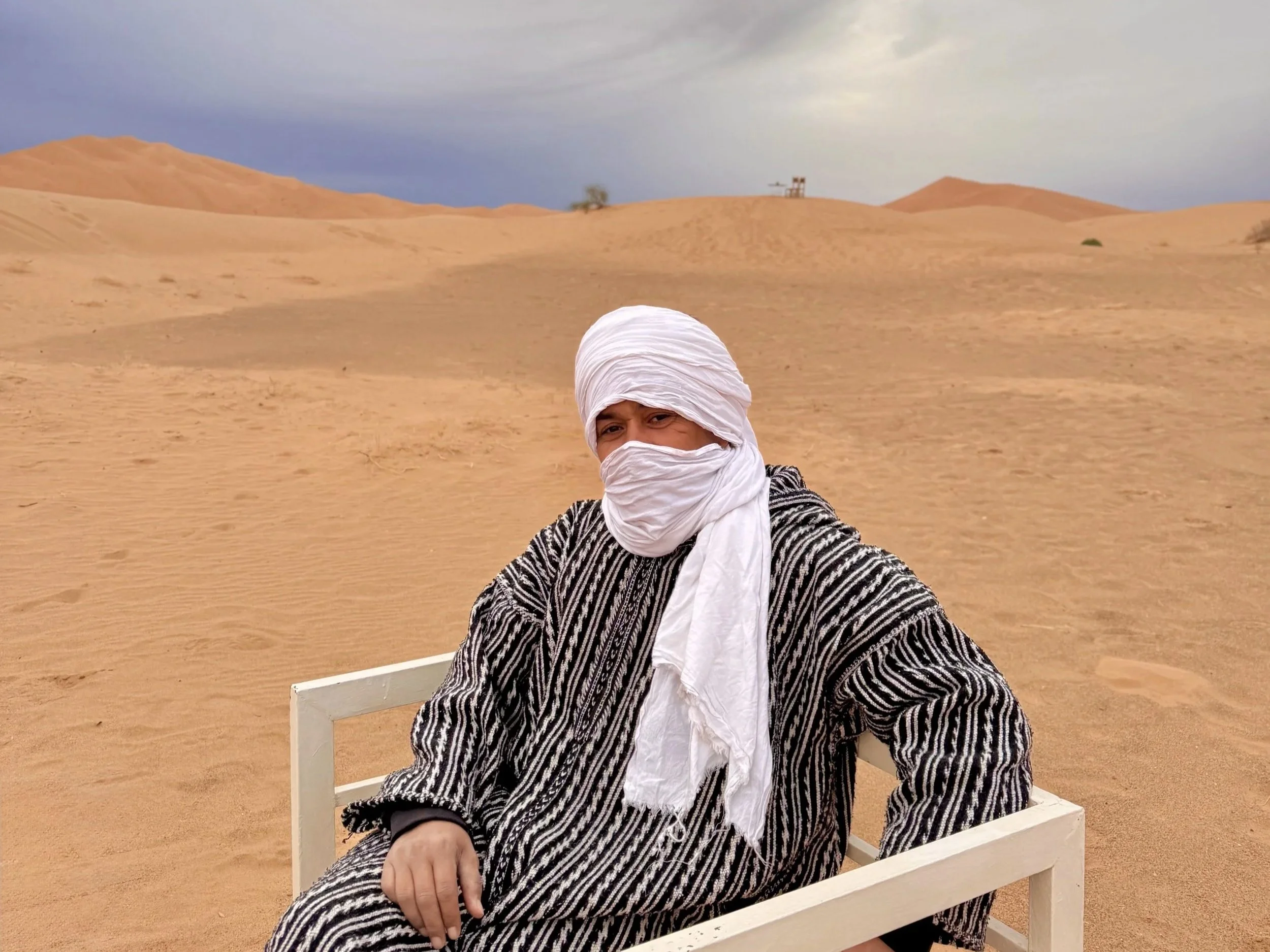
I was born with the sun in my eyes.
I was born in the desert, in the black desert near Erg Chebbi, close to the border between Morocco and Algeria. My family was a big family. My father had three wives, and I was the tenth child. My mother was the youngest wife. We were many brothers and sisters, from different mothers, but one family.
When I was born, it was a good time. There was rain. For nomads, rain is everything. When there is rain, there is life. My family stayed together because the land could support us. But when the rain stopped, everything changed. The land became dry, and life became hard. So we moved.
Nomads follow the rain. When there is no rain, you go where there is water.
I lived my first years in the desert. We did not have the life of children in the city. There was no chocolate, no sweets, nothing like that. Our sweets were dates. We were born, and we worked. Life begins with responsibility.
When I was a child, I was sick. My family thought maybe I would die. There was no hospital, no doctor. They used plants from the desert as medicine. If you survived, you survived. If not, that was life. The desert decides.
Later, I understood my body better. I am very sensitive to humidity. The desert is dry, and that is where I am strong. When the air is wet, it affects me. But as a child, no one knew these things. You just lived.
When I was around ten years old, my father sent me into the desert alone with the camels.
He gave me water and dates and told me to go for three days.
This was normal. You go with the camels, you take care of them, you find food for them, and you bring them back. You are responsible. If something happens, you solve it.
The first time, I was afraid.
I had about twenty camels. Some were pregnant, so I had to be careful with them. During the day, I followed them as they moved through the desert. In the evening, I gathered them together in a circle so they could rest. I stayed in the middle.
At night, it is very cold in the desert. And there are sounds. You hear things you cannot see. Animals, wind, sometimes voices you do not understand. You feel fear.
When I was afraid, I went close to the camels. They protected me.
They would stand around me, and I would sleep near them, sometimes under them, to stay warm. I could feel their heat. Sometimes they would move their heads close to me, like they were telling me not to worry. From that time, I learned something: animals feel you.
They understand you. That is why I respect camels.
If I was hungry, I had to find food. I ate small animals from the desert. I made a fire and cooked them. Water was limited. Maybe five liters for three days. You learn to use nothing and still continue.
On the last day, something happened to me.
I did not know where I was.
Even though I was from the desert, I lost direction. The camels had moved, and the landscape changes. One place looks like another. There are no signs, no roads.
I stopped.
And then I thought: these camels know the way home.
So I trusted them.
I climbed onto one and told it to go home. Slowly, the camels began to move together. They walked through the night. There was wind, a sandstorm, and I could not see clearly. But I stayed with them.
In the morning, when I opened my eyes, I saw my family tent in front of me.
The camels brought me home.
I thanked them. I was crying. That moment stayed with me. Since then, I have always respected the camel. It is not just an animal. It is part of life.
When I returned, my father did not praise me. He did not say “good job.” He counted the camels. He checked that everything was correct. That was enough.
This is how fathers are in the desert. They do not give you too much praise. If they do, you may become weak or proud. Instead, they make you strong.
My mother was different.
She hugged me. She gave me food. She told me to sleep. From her, I received love. From my father, I received strength. Both are necessary.
Later, when there was no more rain, we moved to the village.
We moved because of water.
Water decides everything.
In the desert, sometimes you have no water. If you are lost, you look for anything. Sometimes I would take wet sand and press it to get a little moisture. Even a small drop matters.
The first time I saw running water from a tap, I could not understand it.
I opened it and closed it again and again. Water came out, then stopped, then came again. I was amazed. I was afraid it would disappear. In the desert, water is never like that. You must search for it, dig for it, protect it.
To see it come so easily — it stayed in my mind.
In the village, life changed. We went to school. We learned Arabic and French. Before that, we only spoke Berber. I did not go far in school because I had to work to help my family.
Tourists began to come.
We worked as guides, showing them the desert. From them, I learned languages — French, Spanish, some English, even a little Japanese. Not from school, but from people.
But even now, I say: I prefer the life before.
It was hard, but it had space. People met each other. They shared food. They talked. There was humanity. Now, life is easier, but something is missing.
In the desert, we have a saying: all the land is mine, but nothing belongs to me.
You stay in a place for a time, then you move. You do not hold the land. You live with it.
Families also move. When a son becomes a man and marries, he starts his own life. The father gives him camels and a plan — where he will go during the year. You might only see your family once a year, during a big celebration like Eid.
If there is news, it travels through people.
At the market, nomads meet. They exchange messages. Someone carries your words to your family. This is how communication works. It takes time, but it has value.
Today, technology makes everything fast. But it also removes something.
In the desert, life teaches you to be strong, to not be afraid, and to trust what is around you.
The desert teaches you how to live.
This field testimony was collected by Stephanie Zabriskie at Horaz Luxury Camp, Merzouga, Morocco, on December 10, 2025. It has been edited for clarity while preserving the speaker’s voice and meaning.
